
How to Cook Prime Rib Roast: How Much Per Person

· 9 min read
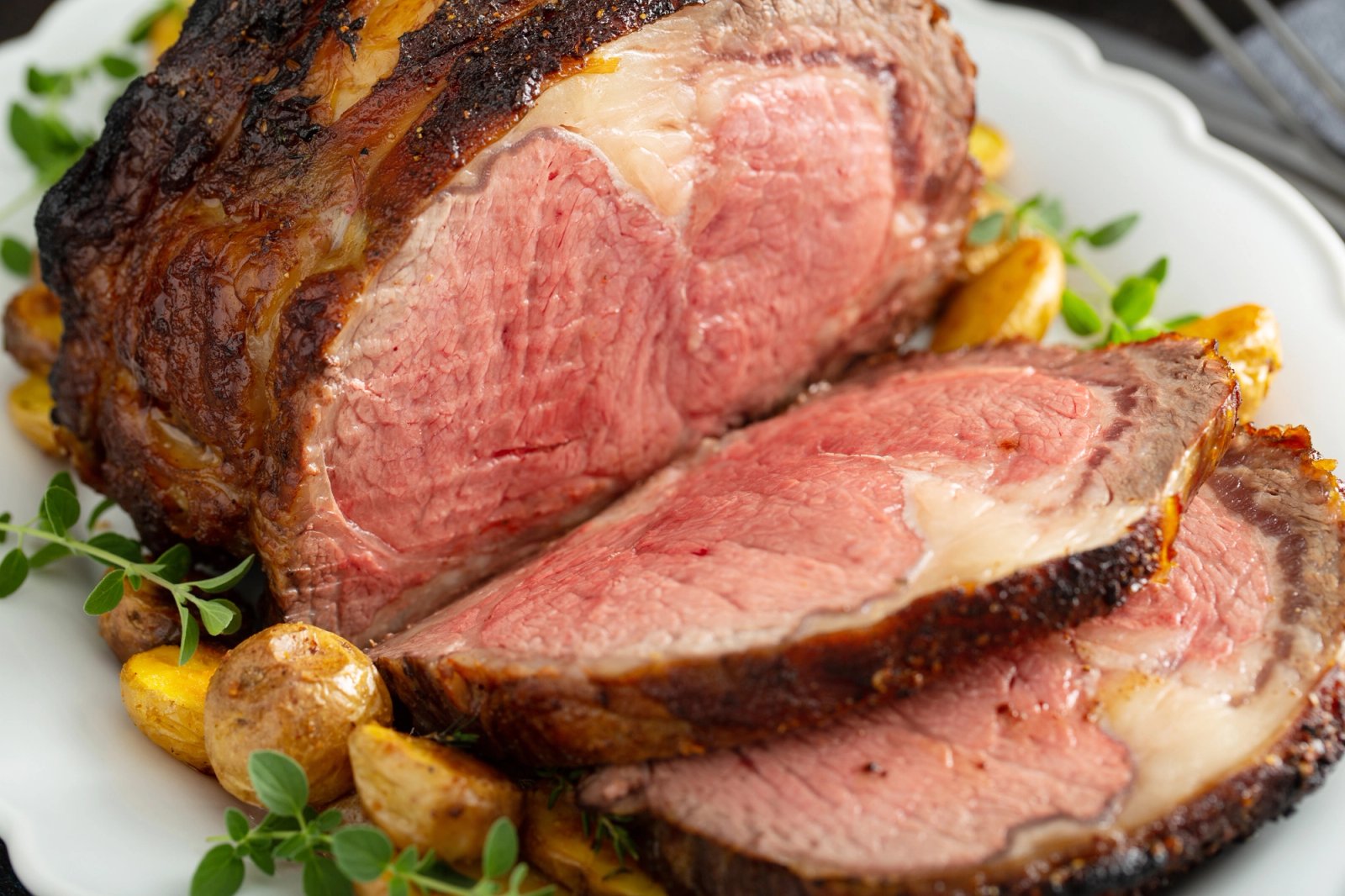
To cook a prime rib roast, salt it a day ahead, roast it low and slow until the centre is a few degrees short of your target, then sear it in a very hot oven just before serving.
This guide from your Calgary butcher also covers how much prime rib to buy per person, how long to cook prime rib per pound, and whether to choose bone-in or boneless. If you are hosting this Christmas, The Better Butcher takes holiday pre-orders for pickup at our Acadia and Marda Loop shops.
Quick answer
As general butcher guidance, buy about 1 lb (454 g) of bone-in prime rib per person, or about 1½ lb if you want leftovers. For a boneless roast, buy about ½–¾ lb per person, or about 1 lb with leftovers. To cook it, roast at about 120°C (250°F) until the centre is just under your target temperature, rest it, then sear it at 260°C (500°F). The portion and cook-time tables below give the details.
In this guide
- Table of Contents
- What is a prime rib roast and is it the same as ribeye
- Bone-in or boneless prime rib
- How much prime rib per person
- How to prep a prime rib roast
- How to cook prime rib (low oven + reverse sear)
- How long to cook prime rib per pound
- Resting and Carving
- Order Your Holiday Prime Rib in Calgary
- Plan your prime rib dinner with us
- Explore Other Guides
- FAQ
Table of Contents
- Quick Answer: How much prime rib per person, and how do you cook it?
- Key Takeaways
- What is a prime rib roast and is it the same as ribeye
- Bone-in or boneless prime rib: which should you order?
- How much prime rib per person
- How to prep a prime rib roast
- How to cook prime rib (low oven + reverse sear)
- How long to cook prime rib per pound
- Resting and Carving
- Order Your Holiday Prime Rib in Calgary
- Plan your prime rib dinner with us
What is a prime rib roast and is it the same as ribeye
A prime rib roast is a beef roast cut from the rib section, the part of the back between the shoulder (chuck) and the loin. It is sold by the number of rib bones, from a two-bone roast for a small table to a full seven-bone rib for a crowd. "Prime rib" names the cut.
It does not mean the beef carries a particular grade.
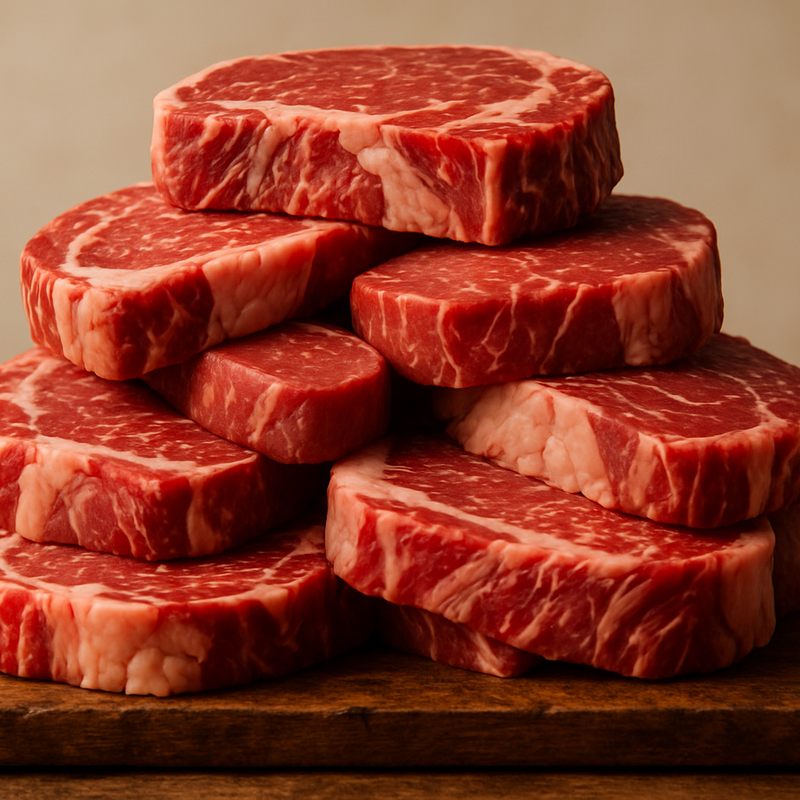
Prime rib and ribeye come from the same muscle. Cut that roast into individual steaks before cooking and you have ribeye steaks; leave it whole and roast it, and you have prime rib. The flavour is similar; the difference is that a roast cooks slowly as one piece, while a steak cooks fast over high heat.
Prime rib vs striploin comes up often too. Striploin sits just behind the rib, is leaner and has a tighter grain, so a striploin roast suits guests who prefer less fat. For the full steak breakdown, see our guide to ribeye vs striploin vs tenderloin.
Bone-in or boneless prime rib: which should you order?
| Cut Option | Bone-in prime rib | Boneless prime rib |
|---|---|---|
| Cooking | Bones shield one side, so it cooks more gently | Cooks a little faster and more evenly |
| Carving | Remove the bones in one piece, then slice | Slice straight through |
| How much per person (general guidance) | About 1 lb; about 1½ lb with leftovers | About ½–¾ lb; about 1 lb with leftovers |
| Best for | A showpiece roast; bones for stock | Smaller tables and easy carving |
Bone-in roasts weigh more per guest because part of what you pay for is bone. As general guidance, one rib bone feeds about two people. If you like the look and flavour of bone-in but dread carving, custom cuts are part of what we do, so ask about your options when you order.
How much prime rib per person
The table below uses general butcher guidance: about 1 lb of bone-in per person (1 1⁄2 lb with leftovers) and about ½–¾ lb of boneless per person (1 lb with leftovers). One pound is 454 g. Adjust for big eaters, children and how many sides you serve.
| Guests | Bone-in | Bone-in with leftovers | Boneless | Boneless with leftovers |
|---|---|---|---|---|
| 4 | 4 lb | 6 lb | 2–3 lb | 4 lb |
| 6 | 6 lb | 9 lb | 3–4½ lb | 6 lb |
| 8 | 8 lb | 12 lb | 4–6 lb | 8 lb |
| 10 | 10 lb | 15 lb | 5–7½ lb | 10 lb |
| 12 | 12 lb | 18 lb | 6–9 lb | 12 lb |
Bone-in roasts are cut by the bone, so round up to the next full bone rather than down.
How to prep a prime rib roast
- Dry brine a day or two ahead: Season the roast all over with coarse salt and set it uncovered on a rack in the fridge. Roughly 1 teaspoon of coarse kosher salt per pound is a common starting point. The dry surface browns better.
- Trim the fat cap if needed: About ½ cm (¼ inch) of fat is plenty. Score it lightly in a crosshatch so it renders.
- Let it sit out briefly: Take the roast out of the fridge about an hour before it goes in the oven so the outside is not ice-cold.
- Season again just before roasting: Add cracked black pepper, plus garlic, rosemary or thyme if you like.
- Set up a probe thermometer: so you can track the centre without opening the oven.
How to cook prime rib (low oven + reverse sear)
The reverse sear cooks the roast gently first and browns it last, so you get less grey meat under the crust and more forgiving timing.
You will need: a prime rib roast (bone-in or boneless), coarse salt, black pepper, optional garlic and fresh herbs, a little oil, a roasting pan with a rack, and a probe thermometer.
- Heat the oven to 120°C (250°F): Set the roast fat side up on a rack in the roasting pan. For bone-in, the bones act as a natural rack.
- Insert the thermometer: Insert the probe into the centre of the thickest part, not touching bone.
- Roast low and slow: Roast until the centre reads about 5–8°C (10–15°F) below your target final temperature. Use the cook-time chart below to plan, but go by the thermometer.
- Rest the roast: Take the roast out, tent it loosely with foil, and rest it for 30 to 60 minutes. Turn the oven up to 260°C (500°F), or as hot as it goes.
- High-heat sear: Rub the surface lightly with oil and return the roast to the hot oven for about 6 to 10 minutes, until the outside is deeply browned.
- Carve and serve: Slice and serve right away. The long rest already happened before the sear.
How long to cook prime rib per pound
At 120°C (250°F), plan on roughly 30 to 35 minutes per pound to reach medium-rare before the sear. That is a general estimate: your oven, the roast’s shape, bone-in vs boneless and the starting temperature all change the time.
| Roast weight | Approx. time at 120°C (250°F) |
|---|---|
| 4 lb (1.8 kg) | 2 to 2¼ hours |
| 6 lb (2.7 kg) | 3 to 3½ hours |
| 8 lb (3.6 kg) | 4 to 4¾ hours |
| 10 lb (4.5 kg) | 5 to 5¾ hours |
| 12 lb (5.4 kg) | 6 to 7 hours |
Add 30 to 60 minutes of resting and 6 to 10 minutes of searing to every time on the table.
Use the doneness chart to decide when to pull the roast from the low oven. The temperature climbs a few degrees during the rest and sear.
| Doneness | Pull from low oven at | Approx. final temperature | Health Canada safe cooking temperature |
|---|---|---|---|
| Rare | 46–49°C (115–120°F) | 50–52°C (120–125°F) | Not listed (below guidance) |
| Medium-rare | 52–54°C (125–130°F) | 55–57°C (130–135°F) | 63°C (145°F) |
| Medium | 57–60°C (135–140°F) | 60–63°C (140–145°F) | 71°C (160°F) |
| Well done | 68–71°C (155–160°F) | 71–74°C (160–165°F) | 77°C (170°F) |
The first three columns are common kitchen doneness targets. Health Canada's safe cooking temperatures for beef pieces and whole cuts, including roasts, are 63°C (145°F) for medium-rare, 71°C (160°F) for medium and 77°C (170°F) for well done. The common rare and medium-rare targets fall below those figures. If you are cooking for anyone pregnant, older, very young or with a weakened immune system, follow the Health Canada numbers.
Resting and Carving
With the reverse sear, the main rest happens before the sear, so the roast goes from oven to board to plate. If you roast at a high temperature instead, rest the meat for 20 to 30 minutes before carving.
To carve bone-in prime rib, stand the roast on its side and run your knife along the bones to remove the whole rack in one piece. Then lay the boneless roast flat and slice across the grain, about 1 cm (½ inch) thick or thicker if your guests like a hearty slab.
Refrigerate leftovers promptly. Health Canada advises reheating leftovers to 74°C (165°F), which takes the pink out of the beef, so leftover prime rib is often best cold in sandwiches.
Order Your Holiday Prime Rib in Calgary
If you are shopping for prime rib in Calgary this Christmas, you can pre-order your Christmas prime rib through the holiday form on our homepage and choose pickup at either shop. Use the comments box to tell us your guest count and preferred style.
- Acadia: 377 Heritage Drive SE, Calgary. 403-252-7171.
- Marda Loop: 3558 Garrison Gate SW, Calgary. 403-454-7272.
Our beef comes from Alberta farms we work with closely, including our Benchmark Angus partners near Picture Butte, and we are committed to hormone-free and antibiotic-free sourcing. You can also shop prime rib and roasts online through Backyard Meats, our online partner for delivery and pickup; that listing describes the roast as 28-day aged.
You can read more about The Better Butcher on our homepage. On Christmas Eve, both shops are open 9 AM to 2 PM, and we are closed on Christmas Day. For special requests, use our contact form for special orders or call either shop.
Plan your prime rib dinner with us
A great prime rib starts with the right size roast and a thermometer you trust. Tell us how
many people you are feeding and we will help you choose between bone-in and boneless. Pre-order your Christmas prime rib for pickup at Acadia or Marda Loop.
Explore Other Guides
Frequently asked questions
How much prime rib per person do I need?
As general butcher guidance, plan on about 1 lb (454 g) of bone-in prime rib per person, or about 1 1⁄2 lb if you want leftovers. For a boneless roast, plan on about ½–¾ lb per person, or about 1 lb with leftovers.
How long do I cook prime rib per pound?
At 120°C (250°F), a prime rib roast takes roughly 30 to 35 minutes per pound to reach medium-rare before the final sear. Add 30 to 60 minutes of resting and 6 to 10 minutes of searing at 260°C (500°F). Times vary by oven and roast shape, so always finish by thermometer.
Should I buy bone-in or boneless prime rib?
Choose bone-in if you want a showpiece roast, gentler cooking near the bone and bones for stock. Choose boneless if you want the easiest carving and less weight per guest.
Is prime rib the same as ribeye?
Prime rib and ribeye come from the same rib muscle. Prime rib is the whole roast, while ribeye steaks are slices of that roast cut before cooking. The flavour is similar; the cooking method is what differs.
Where can I order prime rib in Calgary?
You can pre-order a holiday prime rib from The Better Butcher through the Christmas form on our homepage and pick it up at our Acadia shop on Heritage Drive SE or our Marda Loop shop on Garrison Gate SW. Year-round, you can order through Backyard Meats, our online partner, for delivery or pickup.
Ask your butcher